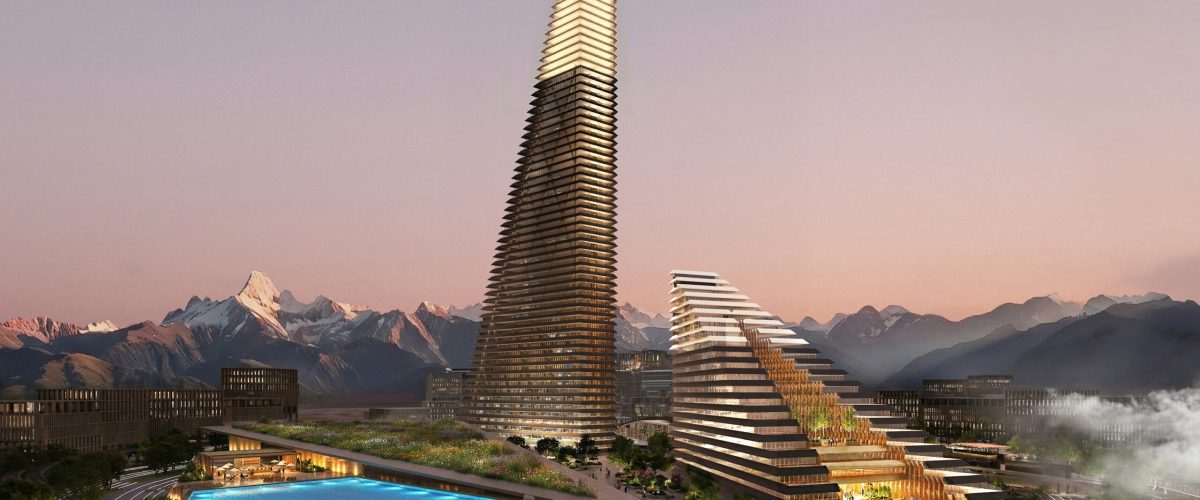
From the plains outside Almaty, the horizon is defined by the long silhouette of the Trans-Ili Alatau mountains. Their ridgelines rise gradually from the steppe, then break into steep glacial valleys and layered rock formations. This shifting terrain becomes the conceptual starting point for the Alatau Iconic Complex and Gateway District, a new mixed-use development designed by Skidmore, Owings & Merrill (SOM) for the emerging city of Alatau City in Kazakhstan.
Rather than imposing a neutral tower form, the complex interprets the surrounding geology as architecture. The mountains provide more than a distant backdrop; their stratified slopes and carved valleys inform the massing and vertical articulation of the buildings. The result is a composition that echoes the rhythms of the landscape, translating the region’s geological character into a contemporary urban landmark.
A mountain-inspired tower composition
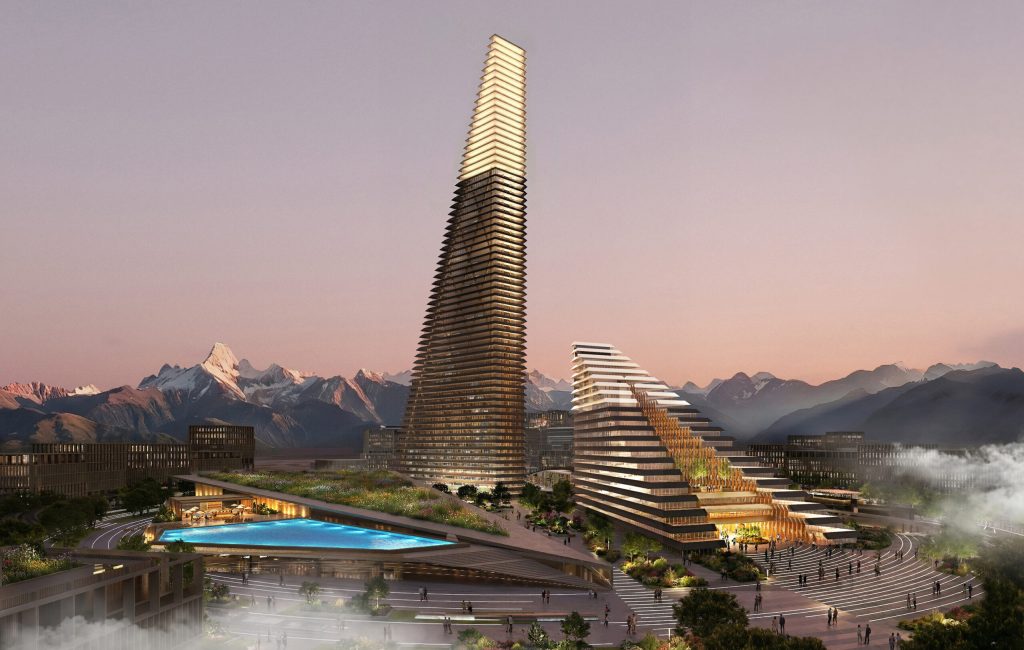
At the centre of the project is a 276,800m2 (2.98 million ft2) mixed-use complex organised around two towers that serve as a gateway to the new district. The primary tower climbs to 272m, its slender profile designed to become the tallest structure in the Almaty region and southern Kazakhstan. Offices and premium residences are stacked vertically within the tower, creating a dense programme where living and working coexist in a single vertical community.
A secondary tower rises to 80m, introducing a luxury hotel and branded residences. The two buildings stand in dialogue with one another: one slender and dominant on the skyline, the other more compact yet integral to the composition. Together they frame the entrance to the broader district, forming a recognisable urban marker visible from across the surrounding plains.
Environmental performance shapes the architecture as much as the formal concept. High-performance façades and integrated shading systems respond to the intense Central Asian sunlight, moderating solar gain while preserving expansive views of the mountains. Large central atria draw daylight deep into the buildings, allowing interior spaces to remain visually connected to the landscape that inspired them.
A terraced podium connecting tower and city
At ground level, the vertical towers meet the city through a three-level podium spanning approximately 58,000m2. Its stepped geometry recalls the foothills of the Alatau range, gradually descending toward the surrounding streets.
This terraced base forms a public landscape rather than a conventional tower plinth. Retail spaces, cultural venues and event halls are arranged across layered platforms that invite movement between interior and exterior spaces. The terraces create places to gather, pause and look outward toward the mountains that shape the project’s identity.
By dissolving the boundary between building and city, the podium allows the development to function as an urban destination rather than an isolated landmark.
A transit-oriented gateway for Alatau City
The complex occupies a strategic position within the masterplan of Alatau City, a new metropolitan development planned near Almaty. Envisioned as a future economic and cultural centre for Central Asia, the city is planned to extend across 88,000ha (217,452 acres) and is situated along the Almaty-Qonaev highway, part of the Western Europe-Western China transport corridor.
The surrounding Gateway District is designed with movement and connectivity in mind. Tree-lined boulevards, shaded pedestrian routes and public plazas create a walkable urban environment, while planned express rail and Light Rail Transit lines connect the district to the wider region.
Infrastructure for emerging forms of mobility is also embedded into the masterplan. The district anticipates micromobility networks and Electric Vertical Take-Off and Landing (eVTOL) aircraft, suggesting a city prepared to operate across multiple layers of transport.
The region’s seismic conditions have also shaped the architecture. Advanced structural systems and damping technologies are integrated into the towers, enabling them to absorb and dissipate earthquake forces while maintaining long-term safety and functionality.
As construction progresses across the plains near Almaty, the Alatau Iconic Complex is intended to act both as a landmark and as an anchor for the new city. Its form draws directly from the mountains that define the region’s horizon, transforming geological memory into a built presence that signals the emergence of a new urban centre in Central Asia.