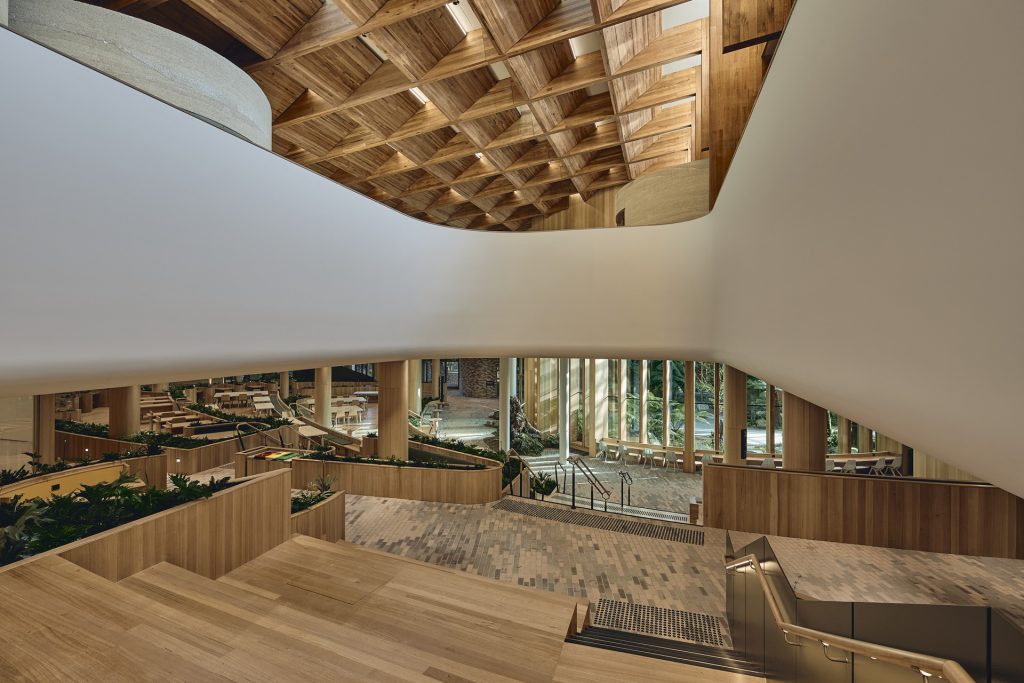
What happens when a university campus is conceived not as a single building, but as a connected landscape of spaces?
In Hobart’s city centre, the University of Tasmania has completed its new flagship campus — a project that reworks a heritage industrial site into a highly connected academic precinct shaped by landscape, adaptive reuse and carbon-neutral design. Designed by Woods Bagot, with landscape architecture by REALMstudios, the campus transforms the former Melville Street site, once home to heritage-listed brick warehouses dating back to 1922.
Rather than prioritising a singular architectural statement, the project focuses on movement, permeability and the experience between buildings. Through-block connections, publicly accessible thoroughfares and integrated landscape unify previously disparate structures into what the design team describes as a campus — not a building.
“We’re creating a campus, not a building,” says Bruno Mendes, Design Director. “We wanted to think about the interstitial, the relationship between zones and the quality of the spaces that you move through between buildings. We created clear navigation through the site, carving out spaces that create opportunities for the interaction of diverse users.”
The 13-metre conservatory dome as civic heart
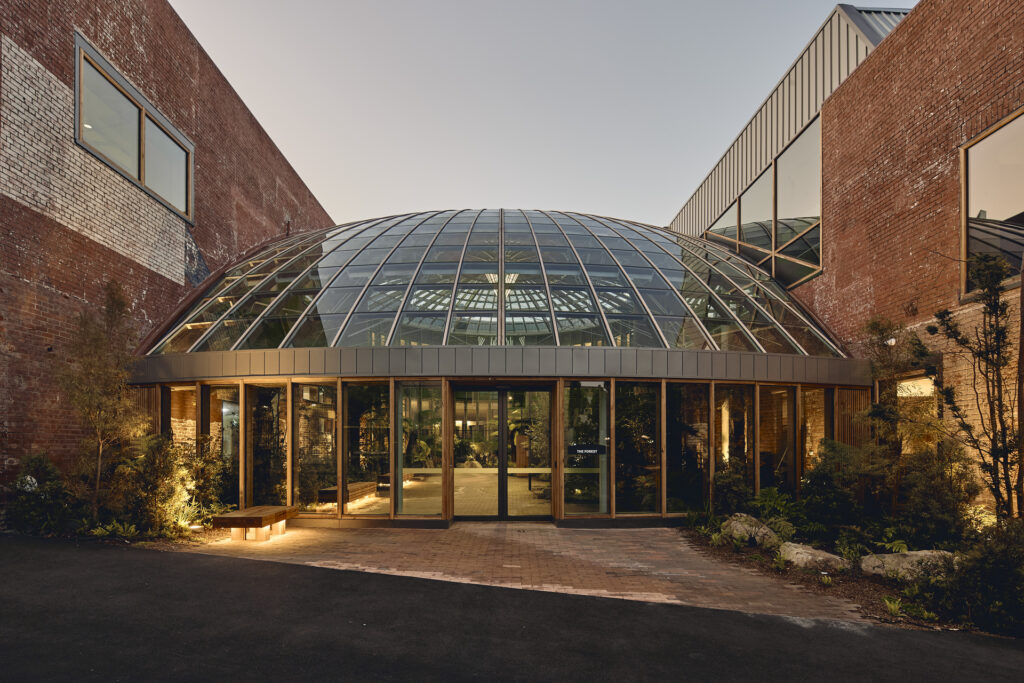
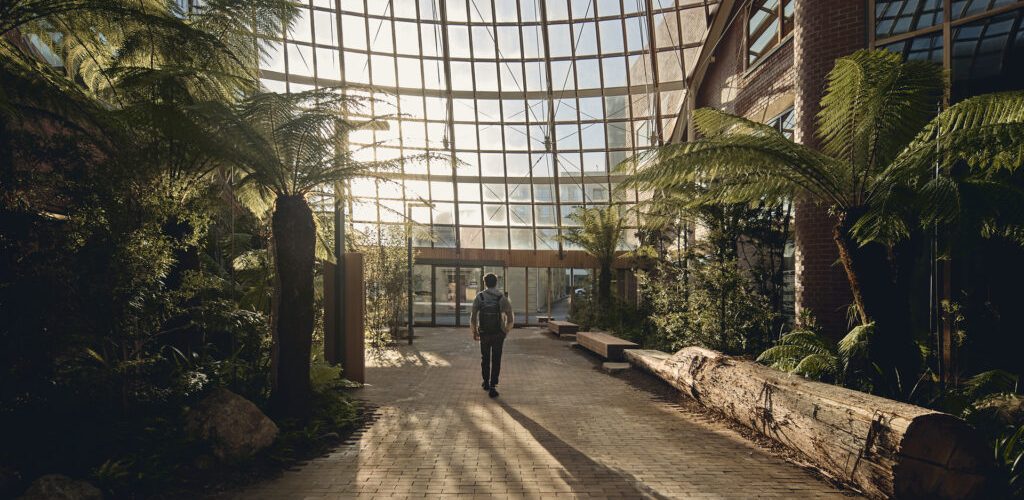
At the centre of the precinct sits the restored 13-metre-high glass-domed atrium of the heritage-listed Forestry Building, originally designed by Morris Nunn in the 1990s. The space once housed a temperate rainforest ecosystem that later deteriorated following a change in ownership.
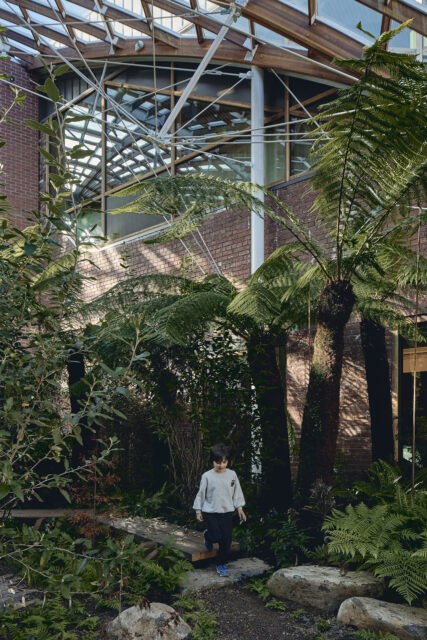
The redevelopment reinstates the indoor urban forest beneath the dome, positioning it as the civic heart of the campus. The forested atrium re-establishes a pre-colonial ecosystem within the city through ethically sourced mature trees, including transplanted specimens from forestry coupes, alongside visible water systems.
Delivering a functioning ecosystem within an enclosed atrium required coordination of soil volumes, irrigation systems and essential building services to support long-term growth. Multiple water sources have been integrated to sustain the landscape, reflecting the technical complexity of maintaining a living environment indoors.
The landscape strategy also incorporates locally sourced stone and timber, reinforcing connections to Tasmania’s material and ecological context.
Designing for flexibility and changing pedagogy
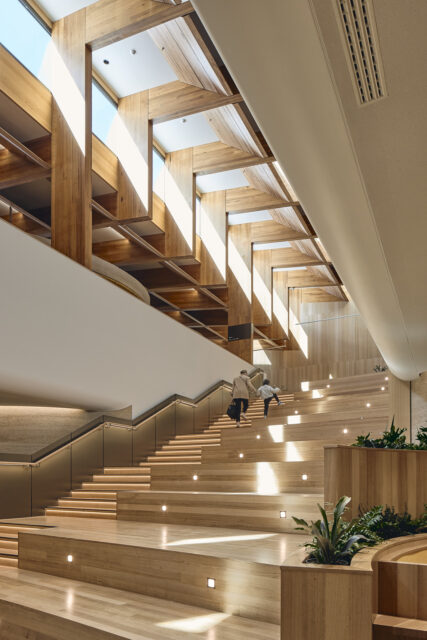
The campus has been conceived as a highly flexible structure, with demountable interior systems enabling adaptation as pedagogical needs evolve. Six spatial typologies organise the environment: focused study zones, ‘alone together’ spaces, public collaboration areas, private collaboration areas, relaxation quarters and meeting places.
“The contemporary learning landscape is changing, with the built environment playing a vital role in the way we approach pedagogical frameworks,” says Sarah Ball, Global Education Sector Leader. “Flexibility, wellbeing and integration of the natural environment have a tangible impact on learning outcomes.”
Vice-Chancellor Professor Rufus Black describes the campus as a place designed for face-to-face learning, from large classrooms to smaller study nooks intended to support interaction among students, teachers and the broader community.
Circular materials and carbon-neutral strategy
The Forest is Australia’s first carbon-neutral university campus. The redevelopment retains 60% of what was already onsite and targets 40% less embodied carbon than comparable buildings.
A circular material strategy underpins the project, prioritising material recovery, eliminating carbon-intensive components and introducing sustainably sourced alternatives. The material palette includes mass timber construction and recycled-content carpets, while hempcrete — a carbon-sequestering bio-composite — has been deployed at what is described as the largest commercial scale in Australasia.
Interpretative signage across the campus details material provenance, flora selection and construction decisions, positioning the building itself as an educational tool.
Now operational, the campus brings together heritage restoration, landscape infrastructure and contemporary education design in a precinct where architecture, ecology and learning intersect.