At a time when most cities are focused on renewal and densification, the development of an entirely new city remains a rare and ambitious proposition. In Western Sydney, that proposition is becoming reality. The master plan for Bradfield City’s First Land Release precinct, known as Superlot 1, has been unveiled by Skidmore, Owings & Merrill (SOM) and Hassell, in collaboration with cultural design partners Djinjama and COLA Studio.
Positioned as Australia’s first entirely new city in more than a century, Bradfield City is not only a large-scale development project. It is presented as a civic, cultural and environmental proposition that places Country at the centre of urban design.
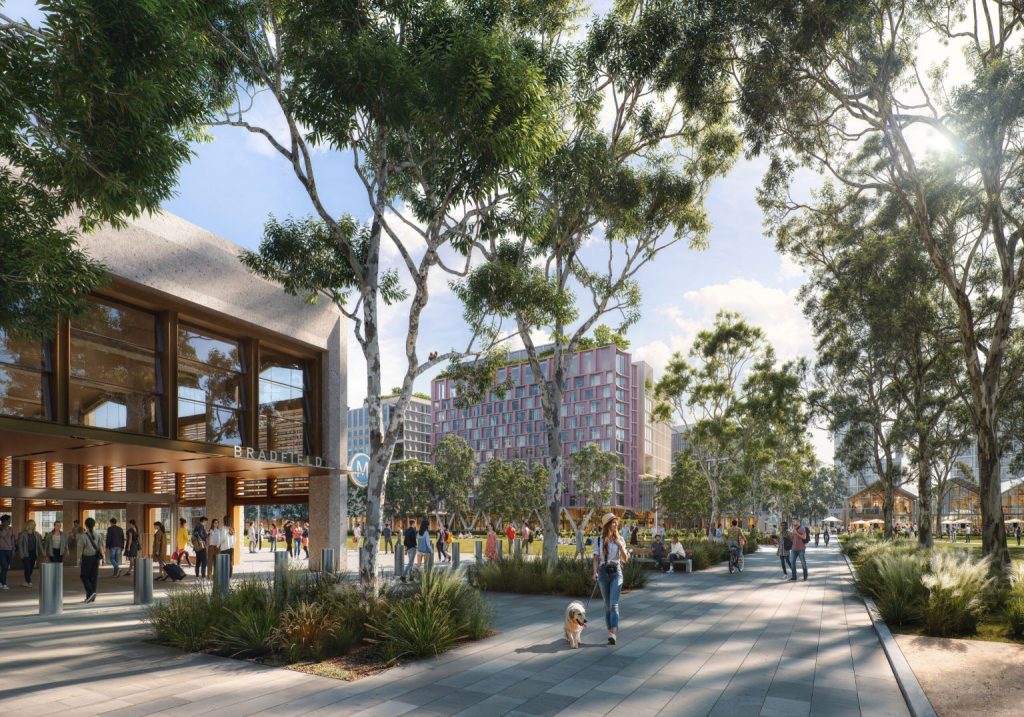
A civic heart built from first principles
Located approximately 50km west of Sydney’s central business district, Bradfield City sits adjacent to the forthcoming Western Sydney International Airport. The airport is expected to drive economic activity across the region, positioning Bradfield as a hub for innovation, education and advanced manufacturing within one of Australia’s fastest-growing corridors.
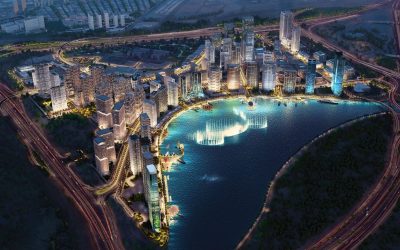
At the core of the emerging city is the 5.7-hectare First Land Release precinct. Conceived as the civic heart of Bradfield, Superlot 1 will deliver more than 1,400 homes, of which 10 per cent are allocated as affordable housing. The programme also includes a university campus, commercial offices, a hotel, childcare facilities, retail and extensive public space.
For the design team, the scale of the opportunity is matched by the weight of responsibility. As described by SOM Senior Associate Principal Michael Powell, designing a new city is both rare and profound. The ambition is to embed resilience, sustainability and innovation into every layer of the urban fabric from the outset.
This ambition is supported by more than A$1 billion ($710m) in public investment. The project is being delivered in partnership with long-term investor and developer Plenary, appointed by the New South Wales Government to lead development of the First Land Release precinct. The structure reflects a coordinated effort to align public priorities for innovation, equity and sustainable growth with private-sector delivery capability.
Embedding country in urban form
What distinguishes Bradfield City from many other master-planned developments is the explicit commitment to Country as a foundational design principle. In the context of First Nations communities, Country refers to the lands, waters and skies to which people are connected through ancestral ties and family origins. Rather than treating this as a symbolic reference, the master plan integrates it spatially and materially.
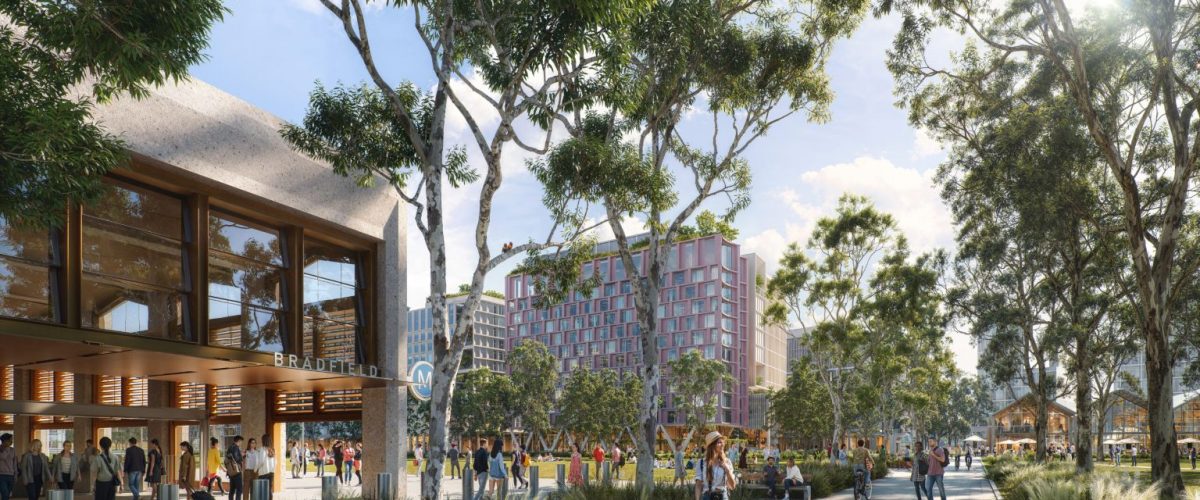
At the centre of the precinct is the Green Loop, a 15-metre-wide linear park that connects the natural systems of Moore Gully with the built environment. The Green Loop is not an ornamental landscape feature. It operates as an ecological corridor and civic spine, reinforcing biodiversity, water systems and pedestrian connectivity while shaping the identity of the precinct.
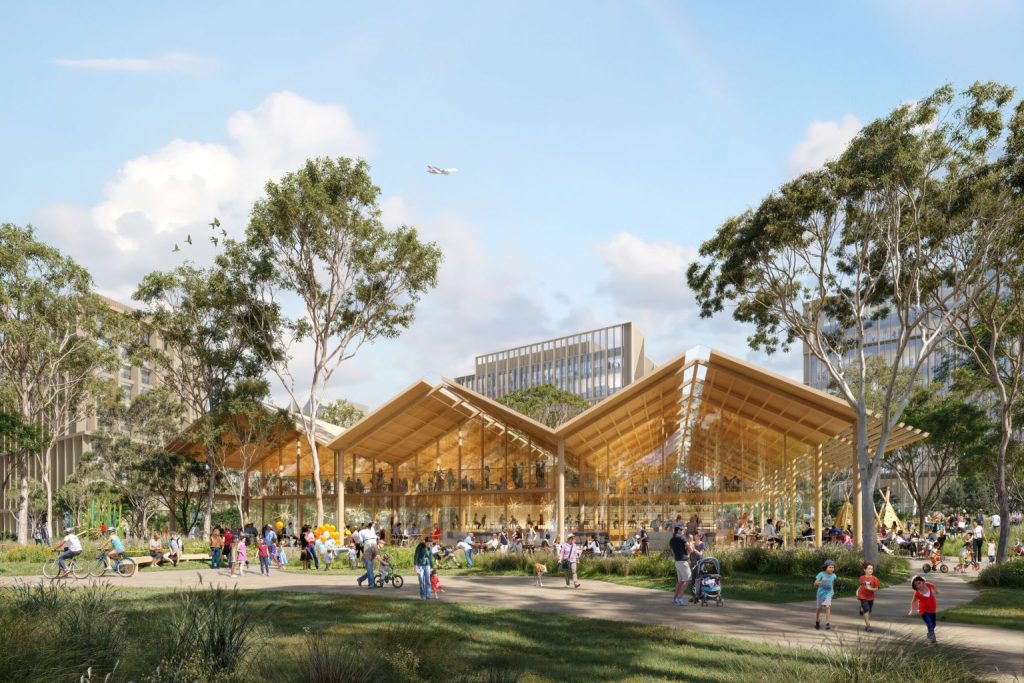
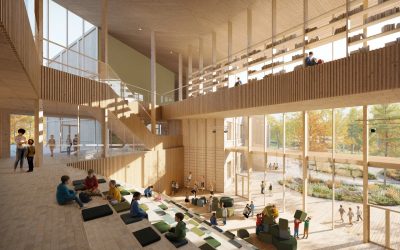
Within this corridor stands a timber pavilion designed as a gathering space for community members of all ages. Its woven canopy of interlocking timber elements draws on the Aboriginal principle of ‘enoughness’, taking only what is needed. The pavilion functions as a prototype for sustainable civic architecture, working in harmony with surrounding water and biodiversity systems rather than asserting dominance over them.
The architectural language of the precinct evolves in response to landscape and cultural narrative. Buildings transition from earthy tones near Moore Gully to lighter forms along the ridgeline, echoing the concept of Sky Country. This gradation reinforces a sense of place that is rooted in context rather than imposed as a neutral global aesthetic.
Climate resilience as urban infrastructure
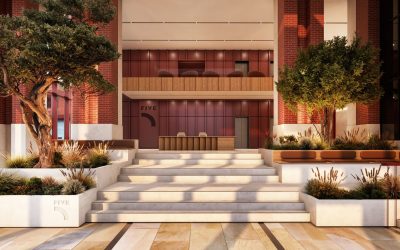
Climate adaptation is not positioned as a secondary layer of technology but as an organising principle. The material palette prioritises low-carbon, high-performance materials, including terracotta and timber, selected to reduce embodied energy. Passive design strategies are reinforced through green roofs, biosolar systems and water-sensitive infrastructure.
The integration of water management and biodiversity into the core of the precinct reflects an approach that treats landscape and infrastructure as inseparable. The Green Loop connects natural and built systems, while public spaces are designed to support environmental performance alongside social activity.
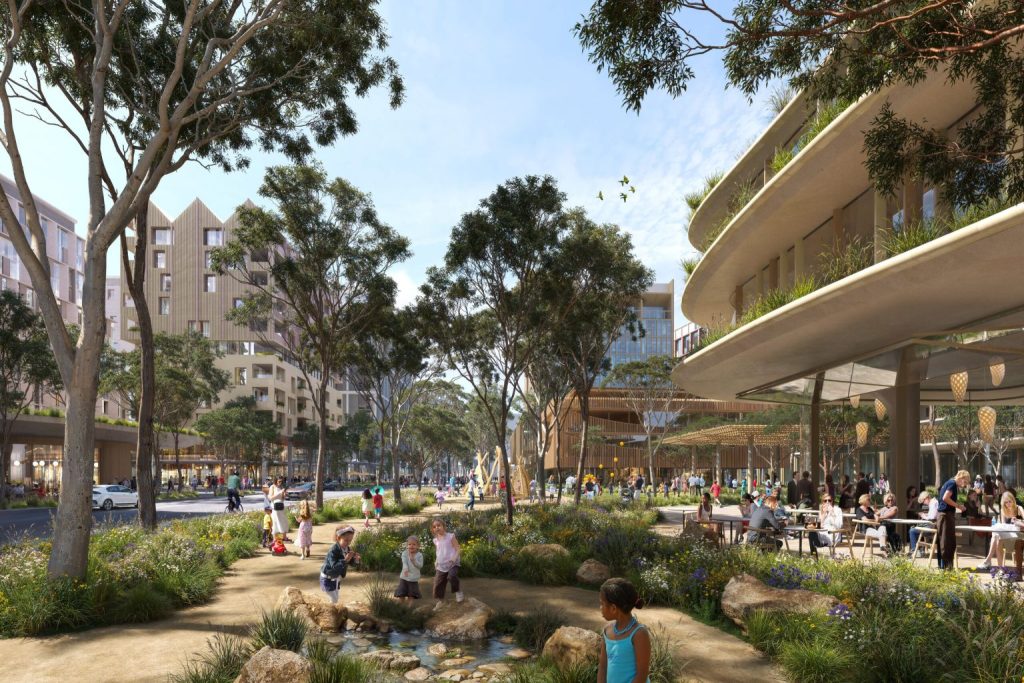
Kevin Lloyd, Principal at Hassell, describes the intent as creating a precinct where nature and urban life are intertwined, ensuring that Bradfield City feels welcoming, sustainable and uniquely of its place. This integration of environmental systems with civic life is central to the project’s claim of reframing what a new city can be.
Positioning a new urban economy
Bradfield City is also conceived as an economic catalyst. Its adjacency to the new international airport establishes a direct link between global connectivity and local opportunity. The master plan positions the city as a centre for advanced industries, research and innovation, supported by multimodal transport connections.
As a key anchor of the Western Parkland City, Bradfield is intended to leverage infrastructure investment to create long-term growth. The presence of a university campus within the First Land Release signals an ambition to integrate education, industry and urban life from the beginning rather than as later additions.
In this respect, the project moves beyond residential expansion. It proposes a mixed-use urban core designed to attract talent, support enterprise and foster community. The inclusion of affordable housing within the initial phase further reflects an attempt to balance economic development with social inclusion.
Reframing the idea of a new city
Bradfield City’s First Land Release does more than introduce new housing or commercial space. It articulates a framework in which cultural recognition, environmental stewardship and economic ambition are treated as interdependent.
By placing Country at the core of the master plan, the design team has sought to ensure that identity is not retrofitted but embedded from inception. Landscape is not residual space between buildings but the organising structure. Climate resilience is not an add-on but a baseline condition. Public investment is not limited to infrastructure but extends to civic life and social equity.
If realised as envisioned, Bradfield City will stand as a contemporary test of what it means to build a city from first principles in the 21st century. Its significance lies not only in its scale or its proximity to a major airport, but in its attempt to ground a new urban centre in the cultural and ecological realities of its place.