
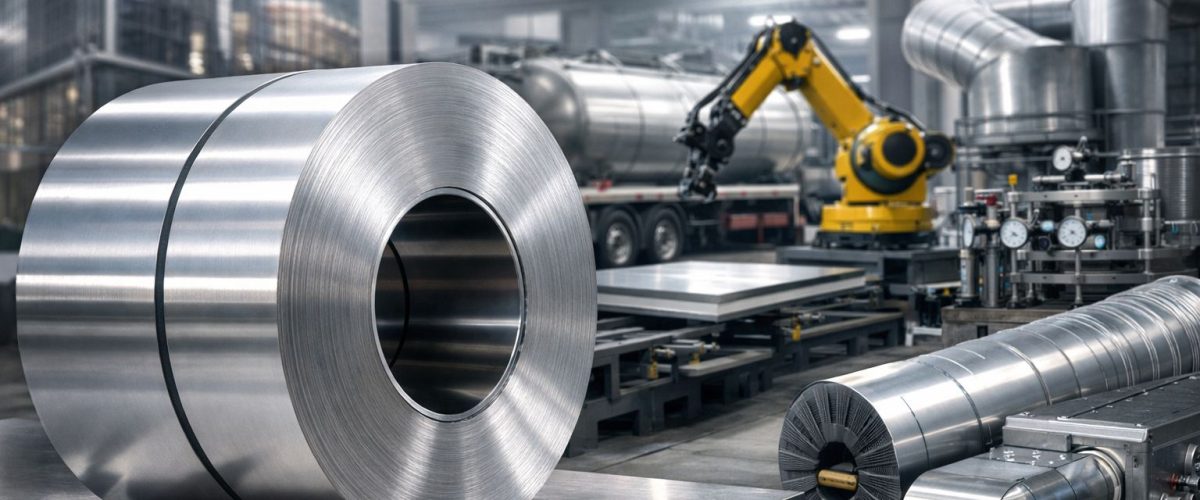
A new certified alternative to Grade 316L stainless steel is entering corrosion-sensitive sectors including HVAC, architectural fabrication and transport systems.
Aperam has introduced Grade 316A (1.4682), a patented austenitic stainless steel engineered to deliver corrosion resistance and mechanical performance equivalent to 316L (1.4404), while reducing molybdenum content by more than 75% through an optimised alloy composition.
Developed by the company’s Innovation Lab, the grade is positioned as a cost-efficient substitute designed for direct industrial integration.
Aperam is a global producer of stainless, electrical and specialty steels as well as recycling and renewables solutions.
Reducing molybdenum while maintaining corrosion resistance
Grade 316A has been engineered to match the performance characteristics of 316L by using silicon to compensate for the reduction in molybdenum content. According to the company, this alloy balance enables comparable corrosion resistance and mechanical properties while lowering overall alloy dependency.
The material is fully certified and has undergone extensive corrosion and mechanical testing to validate its suitability across industrial environments where 316L is traditionally specified.
Frederico Ayres Lima, CEO of Stainless and Services & Solutions Europe at Aperam, stated that the new grade establishes a revised cost reference for corrosion-resistant stainless applications while maintaining availability and reliability.
Direct replacement without production adjustments
From a manufacturing perspective, Grade 316A is designed as a plug-and-play solution. It can replace 316L without modifications to production parameters, including in deep drawing and other demanding forming operations.
No tooling changes are required, helping manufacturers avoid downtime and additional transition costs.
The grade is available in thicknesses ranging from 0.06 mm to 15 mm and widths up to 2,000mm, supplied in surface finishes compliant with EN 10088-2.
With a high share of recycled input, the material also supports EU Taxonomy requirements and contributes to manufacturers’ Scope 3 emissions management objectives without requiring redesign of end products.
Validated for building systems, processing and mobility applications
Grade 316A has been validated for use in a range of corrosion-exposed applications, including:
- HVAC components such as pumps, heat exchangers and ventilation units
- Food and cosmetics processing equipment
- Architectural elements and flues
- Transport applications including tanks, trailers and mobility systems
- Water treatment and storage systems
- CCUS and electrolyser systems
Bertrand Petit, 316A Project Leader, stated that the material aligns with corrosion resistance requirements across multiple industrial environments while providing manufacturers with additional flexibility in material selection.
The development forms part of applied innovation initiatives within the Aperam Innovation Lab, which brings together more than 150 specialists focused on large-scale industrial validation of materials.