Reimagining a New York landmark for the demands of contemporary hospitality and residential living poses a fundamental question: how can a building be comprehensively transformed without compromising the architectural identity that defines it?
At the Waldorf Astoria New York, that question has shaped a multi-year intervention combining preservation, restoration and adaptive reuse across 1.6 million square feet. The result has now been recognised with a Lucy G. Moses Preservation Award from the New York Landmarks Conservancy, one of the city’s highest honours for preservation excellence.
Led by Skidmore, Owings & Merrill (SOM), the project converts 96% of the former 1,400-room hotel into a 372-unit luxury residence and a 375-key boutique hotel, while restoring 62,000ft2 of landmarked interiors dating back to 1931.
Adaptive reuse across 44 storeys
When the Waldorf Astoria opened in 1931, it set a new benchmark for American hospitality. Designed by Schultze & Weaver, the 44-storey, 625ft-tall skyscraper became an emblem of Art Deco design and a centrepiece of New York’s cultural life.
Over subsequent decades, modernisation efforts altered the building’s circulation patterns, finishes and lighting schemes. SOM’s approach sought to reposition the property for its next century while retaining the essence of its original architectural intent.
Today, the building accommodates 372 residential units above a five-star, 375-key hotel. On levels seven through 15, former guestrooms have been reconfigured and doubled in size, with access to a landscaped terrace created on a previously unused setback. Hotel interiors were designed by Pierre-Yves Rochon.
Above, the residential floors work within the existing structural grid of columns, beams and punched windows to produce 125 distinct layouts among the 372 homes — an unusually high level of variation for a tall building. Interiors for the residences were designed by Jean-Louis Deniot, blending Art Deco references with a contemporary sensibility.
Restoring public spaces and architectural symmetry
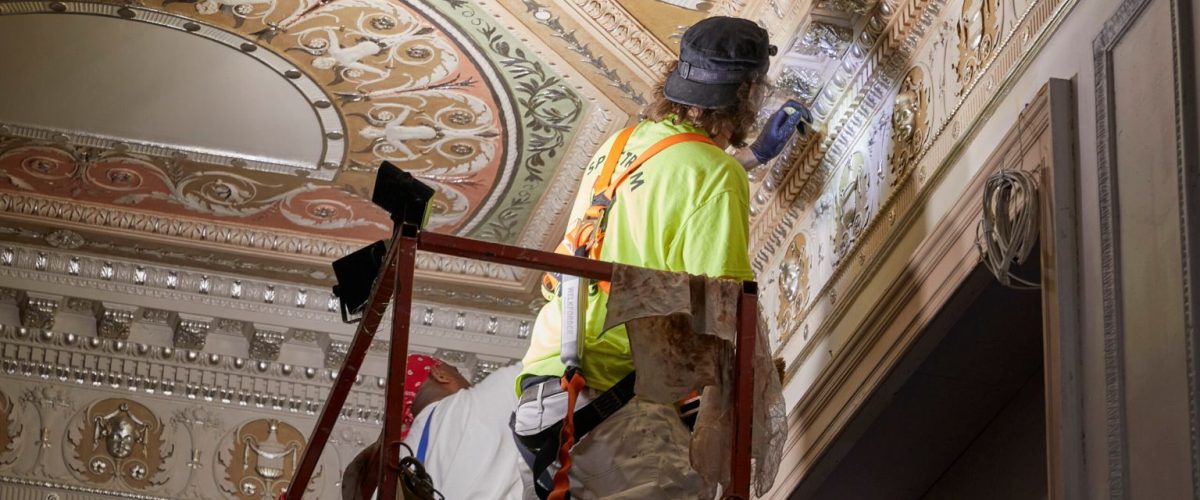
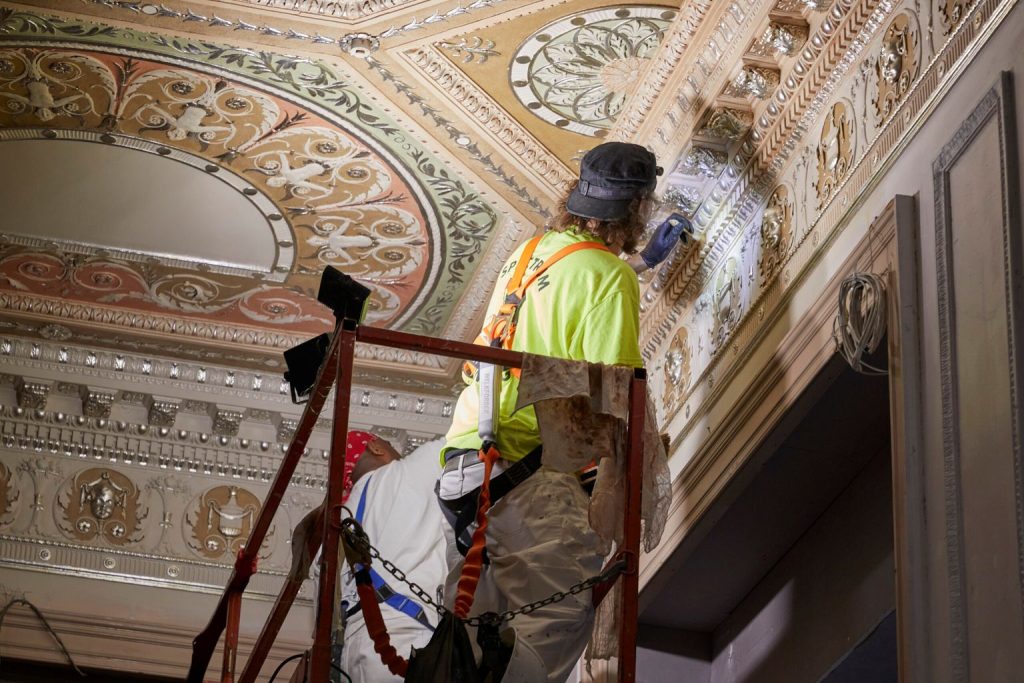
While most of the building underwent conversion, the remaining 4% — approximately 62,000ft2 encompassing the landmarked lobbies, corridors, ballroom and event spaces — was subject to careful restoration in collaboration with Higgins Quasebarth & Partners and Building Conservation Associates.
Historically, guests entered at street level before ascending to a main floor organised as an enfilade of public rooms. Over time, retail insertions and later renovations disrupted these sequences. The recent works removed retail interruptions, reinstated corridor connections such as the East Arcade and Peacock Alley, and restored the alternating spatial rhythm of the original plan.
In the Park Avenue Foyer, archival specifications and a black-and-white photograph guided the reconstruction of the original lighting concept, replacing a later chandelier with backlit luminous marble panels. Mechanical equipment that had occupied space above the Lexington Avenue Foyer for decades was removed, allowing the ceiling to be raised and natural light reintroduced.
At the centre of the building, the original clock lounge has been returned to its Art Deco character. Unoriginal wood panelling, a ceiling frieze and circulation barriers were removed. Maple burl veneer once again lines the walls, entrances have reopened, and the space’s full height has been restored.
On the third level, the Silver Corridor — linking the Jade, Astor and Basildon Rooms — underwent a chromatic restoration. Murals salvaged from the original Waldorf Astoria hotel of the 1890s were cleaned by ArtCare Conservation to remove decades of discolouration. Grey harewood panelling, once replaced with darker finishes, has been reinstated. In the Basildon Room, layers of overpainting were stripped back to reveal the original reds, greens and silvers.
Exterior renewal and performance upgrades
Externally, the Waldorf retains its characteristic “wedding cake” massing, culminating in copper-clad twin towers. The limestone façade, which had darkened over time, was cleaned and repaired. Decorative spandrels were replicated, deteriorated bricks replaced, and more than 20 setbacks — previously filled with mechanical equipment — have been converted into communal and private terraces. Formerly unused pinnacles now contain penthouses.
Among nearly 5,600 windows, only one remained unaltered prior to the project. That surviving example served as the template for restoring original frame profiles and dimensions. On residential levels, 820 window openings were expanded by one foot to increase daylight penetration. New double-glazed windows improve acoustic separation and energy efficiency.
In the Grand Ballroom, a three-storey venue accommodating up to 1,500 guests, the ceiling scheme originally envisioned in 1931 but never completed has now been realised using archival drawings. Structural separation joints were introduced to address longstanding acoustic transfer between the ballroom and adjacent guestrooms.
On the 25th floor, the former Starlight Roof nightclub has been transformed into the Starlight Pool, illuminated by a new skylight and surrounded by approximately 50,000ft2 of residential amenities, including a fitness centre, wellness lounges, a library, theatre and children’s playroom.
Completed in 2025, the project operates within the framework of New York City Individual and Interior Landmark status. Through a combination of preservation, restoration and large-scale conversion, the Waldorf Astoria New York re-enters the city’s architectural landscape not as a singular hotel, but as a hybrid model of boutique hospitality and private residences — retaining its 1931 identity while adapting to contemporary demands.