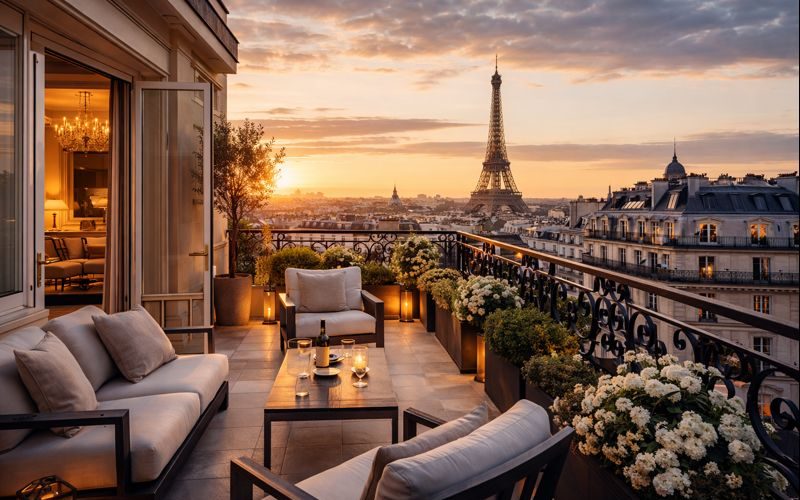
Paris’s luxury real estate market, which experienced a remarkable surge in 2025, is showing early signs of cooling in 2026, as political instability and potential fiscal measures weigh on affluent buyers. While the city remains a prime destination for the ultra-wealthy, the market is now shifting from a period of record-breaking growth toward a more cautious and selective environment.
Demand soared in 2025, then momentum slowed
The previous year saw transactions rise by 22%, reaching the highest benchmark in 20 years, with properties priced over €1 million ($1.2 million) experiencing similar growth, according to Barnes, a leading luxury real estate agency that controls more than 25% of Paris’s high-end market. This surge followed a challenging 2023–2024 period, when higher interest rates and public unrest, including videos of violent protests, contributed to a market contraction, Bloomberg reports.
“Rising political uncertainty and potential wealth taxes are making ultra-wealthy buyers more cautious, slowing Paris’s luxury property market in early 2026.”
Wealthy residents consider selling amid political and fiscal uncertainty
The recent slowdown in Paris’s luxury market is closely tied to political instability. No single party currently holds a majority in the French government, which has struggled to pass budgets since the snap elections in 2024 under President Emmanuel Macron. This uncertainty has created a sense of caution among wealthy property owners, many of whom are reconsidering their long-term investment in the city.
Adding to the concern is a proposed wealth tax of 2% on fortunes exceeding €100 million ($117.5 million), suggested by economist Gabriel Zucman. Critics argue the levy could either generate €23.5 billion annually or drive €5 billion out of France if high-net-worth residents choose to exit. Notable figures such as Bernard Arnault have publicly described the proposal as a measure that could “destroy the French economy,” Bloomberg reports.
Barnes has observed that a significant portion of its clientele (individuals worth $30 million or more) are considering selling their properties and relocating, with popular destinations including Italy, Switzerland, Luxembourg, and Israel.
Paris remains attractive, but global competition intensifies
Despite these pressures, Paris retains its appeal for international buyers. Tzipine notes that American buyers remain active, helping support the city’s 2026 outlook. Nevertheless, other global cities are emerging as attractive alternatives due to relaxed tax regimes and investment incentives. Milan, Dubai, Miami, Marbella, and Madrid are drawing ultra-wealthy families and investors who previously might have focused on Paris.
While the luxury market in Paris is cooling, it remains resilient at the top end, particularly for uniquely located or architecturally exceptional properties. For now, the market is shifting from aggressive expansion to selective stability, with buyer behaviour increasingly influenced by political developments and fiscal policy in France.