Project Overview
| Type | Modern and contemporary art museum |
| Location | Saadiyat Island, Abu Dhabi, United Arab Emirates |
| Developer | Department of Culture and Tourism – Abu Dhabi (DCT Abu Dhabi) in collaboration with Solomon R. Guggenheim Foundation |
| Design Architect | Frank Gehry, Gehry Partners LLP |
| Executive Architect | Adamson Associates (International) – Abu Dhabi |
| Main Contractor | Joint venture between Six Construct (BESIX Group) and Trojan General Contracting |
| Start of Construction | 2021 |
| Planned Completion | Between 2026 and 2027 |
| Building Size | 42,000m2 (450,000ft2 approximately) |
Guggenheim Abu Dhabi, designed by Pritzker Prize–winning architect Frank Gehry, is advancing through active construction on Saadiyat Island as one of the most ambitious cultural projects currently underway in the Middle East, with completion targeted between 2026 and 2027. Developed by the Abu Dhabi Department of Culture and Tourism (DCT Abu Dhabi) in collaboration with the Solomon R. Guggenheim Foundation, the museum is being delivered by a joint venture between Six Construct and Trojan General Contracting.
The project forms a key component of the Saadiyat Cultural District, alongside landmark institutions such as Louvre Abu Dhabi and the Zayed National Museum, reinforcing Abu Dhabi’s long-term cultural and creative industries strategy. Conceived as a platform for exhibitions, research, and academic and cultural exchange, the museum is intended to support both regional and international contemporary art discourse.
Construction has been underway since 2021, with completion currently targeted between 2026 and 2027. Upon completion, Guggenheim Abu Dhabi is expected to become the largest institution within the global Guggenheim network.
Frank Gehry’s vision for Guggenheim Abu Dhabi
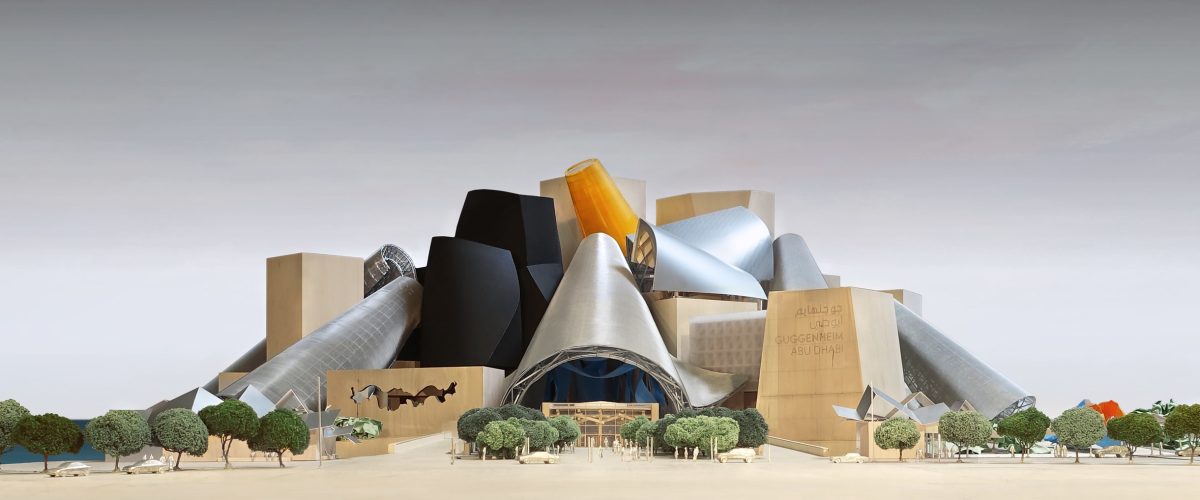
The museum is designed by Frank Gehry, one of the most influential figures in contemporary architecture and the designer behind globally recognised cultural institutions such as the Guggenheim Museum Bilbao. Gehry’s work is known for its sculptural forms, material experimentation, and ability to create iconic buildings that reshape their urban and cultural contexts. Guggenheim Abu Dhabi is conceived as an experiment in 21st-century museum design, presenting an alternative approach to visitor circulation and exhibition layouts.
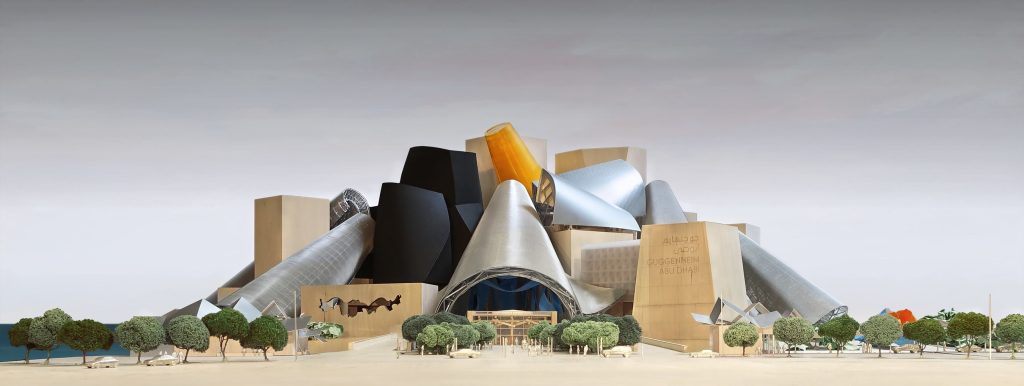
The building comprises clusters of galleries arranged around a central open-air courtyard, with additional warehouse-scale galleries extending outward. A defining feature of the design is a series of asymmetrical, cone-shaped volumes that surround the main structure. These cones function as entrances and outdoor exhibition spaces and are tipped and oriented to open towards the surrounding desert and coastal landscape.
The architectural language draws inspiration from regional vernacular forms. The cone-shaped galleries reference traditional Islamic wind towers and Bedouin tents, integrating cultural context into the contemporary architectural expression.
Designing for Abu Dhabi’s desert climate
The design incorporates climate-responsive elements suited to Abu Dhabi’s desert environment. Covered courtyards and monumentally scaled cones are designed to promote natural cooling and ventilation by drawing air through interior spaces, reducing heat gain during peak summer conditions.
These passive strategies are derived from traditional wind tower concepts found across the Middle East. The approach reflects an emphasis on sustainable design measures integrated directly into the architectural form, rather than applied as standalone systems.
Guggenheim Abu Dhabi’s exterior architecture
The project’s complex exterior geometry closely aligns with the original design intent, articulating a deliberate contrast between curvilinear metal-clad volumes and robust rectilinear structural cores that is characteristic of Frank Gehry’s architectural language. The composition emphasises a dynamic interplay between sculptural form and engineered massing, with fluid envelopes supported by rigorously controlled secondary steel frameworks and ribbed structural systems.
Interior spaces and exhibition environments
The interior spaces of Guggenheim Abu Dhabi are organised to support a wide range of contemporary art practices and exhibition formats. The museum incorporates a mix of gallery types, including large-scale warehouse-style galleries alongside more contained exhibition spaces arranged around a central courtyard. Visitor circulation is designed to accommodate both horizontal and vertical movement between clustered gallery volumes, connected through internal links and catwalks. The interior environments are planned with an emphasis on flexibility, enabling curatorial adaptability across exhibitions, installations, and public programmes.
Construction progress and delivery timeline
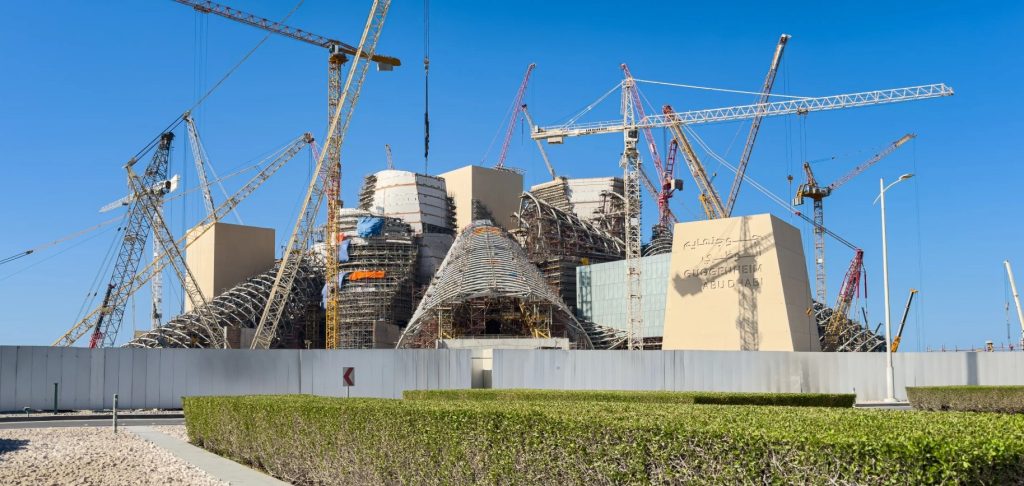
The main construction contract was awarded in 2021 to a joint venture between Six Construct, a subsidiary of BESIX Group, and Trojan General Contracting, a subsidiary of Alpha Dhabi Holding. The contract covers all construction works, excluding foundations, which had been completed prior to the 2021 award as part of early enabling works on Saadiyat Island.
The building is being constructed using a combination of steel, concrete, wood, and aluminium. Construction planning has focused on optimising sequencing, procurement, and construction methodologies to address the complexity of the geometry and coastal site conditions.
Engineering, BIM, and specialist consultants for Guggenheim Abu Dhabi
A wide range of international consultants and specialist firms are involved in the project delivery. Adamson Associates (International) – Abu Dhabi served as Executive Architect during the schematic design phase between 2008 and 2010, coordinating multidisciplinary consultants during the project’s early planning and design development period.
DNEC, an international engineering consultancy, provided Building Information Modelling (BIM) services, including MEP modelling at LOD 300 and quantity surveying derived from the BIM model. Dutch Digital Delivery Company (DDDc) has supported BIM execution across façade, roof, glazed walls, and specialist packages, and continues involvement through construction and as-built stages.
HMFairview acted as Lead Civil Engineer during schematic and design development phases, delivering roads, utility corridors, grading, and stormwater strategies within the reclaimed coastal context of Saadiyat Island.
Structural engineering, reinforcement systems, and materials supply
Dextra Group supplied structural reinforcement systems for the project, including approximately 140,000 Bartec couplers, 30,000 RepairGrip couplers, 50 tonnes of Geotec rock bolts, and 199 sets of DCP anchors. These systems were used to reinforce concrete elements, stabilise surrounding rock formations, and secure seawall structures along the coastal edge.
Additional specialist engineering input includes seismic studies and fire-fighting pipe support design undertaken by AAPL Consultants, with WSP acting as consultant and NAFFCO referenced as contractor for this scope.
Lighting design
Lighting design for Guggenheim Abu Dhabi is being delivered by L’Observatoire International. The scope includes façade and site lighting, as well as interior public areas such as lobbies, galleries, cafés, restaurants, retail spaces, and the auditorium.
The lighting strategy supports the flexible curatorial layout envisaged by the architectural design, accommodating both horizontal and vertical exhibition spaces connected by catwalks and clustered gallery volumes.