In Rotterdam’s Waterkant district, a new architectural idea is taking shape—one that approaches sustainability not only as technology or policy, but as spatial experience.
Among five design concepts unveiled for the House of Shift, the proposal by Dutch architecture practice Mecanoo imagines the building as a landscape of circular architecture. Conceived as the first node in a future global network of sustainability hubs, the House of Shift Rotterdam proposes architecture as a platform where environmental awareness, public life and experimentation intersect.
Designed by Francine Houben and the team at Mecanoo, the landmark assembles a hill, a tower and an elevated box into a striking composition. A timber sphere balanced on the edge of the structure completes the silhouette. The geometry is intentionally elemental—simple enough to sketch in a few lines—yet layered with symbolic meaning about the systems shaping the planet.
The complex is envisioned not as a conventional building but as a sequence of environments where visitors encounter ideas of circularity, climate action and ecological integration through architecture itself.
A landscape for encounter and reflection
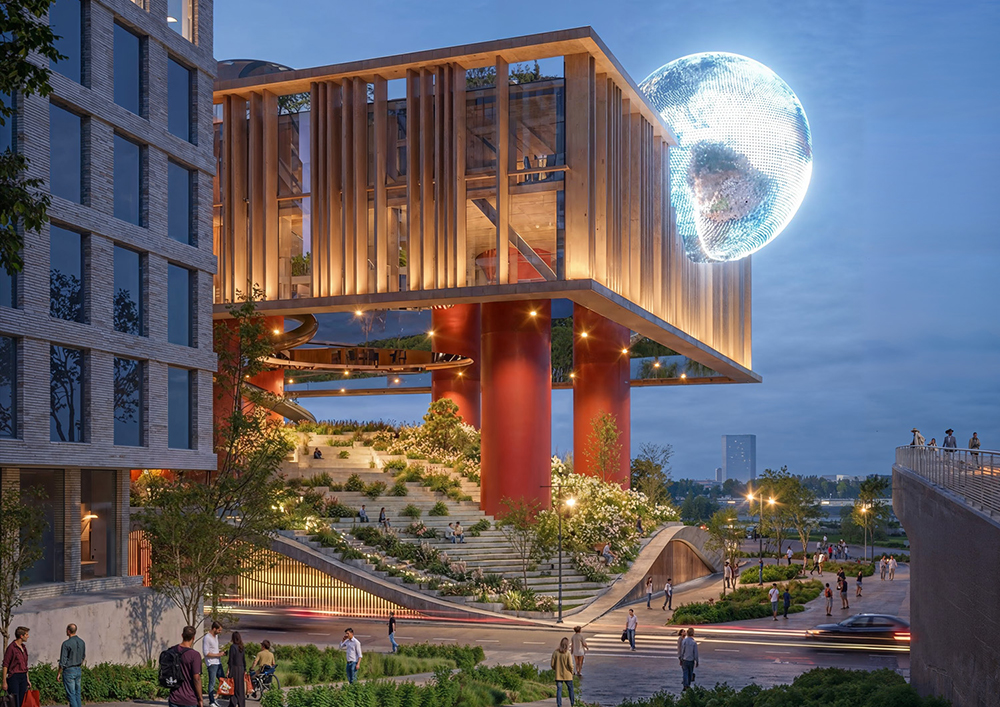
The architectural journey begins with a hill that forms the physical and symbolic base of the complex. Embedded within it lies the Great Hall, a gathering space constructed from urban-mined recycled concrete. The material is shaped using earth-moulding formwork, giving the structure a raw geological character that echoes the ground from which it rises.
Inside, the hall is softened by a warm timber acoustic ceiling. The atmosphere is deliberately contemplative: a place to meet, eat and exchange ideas. In contrast to the technological rhetoric often associated with sustainability, the space emphasizes human presence and shared experience.
Above the hill sits the World of Sounds, an open acoustic landscape sheltered beneath a mirrored soffit that reflects the sky and surrounding city. At its centre, a circular void—the Circle of Hope—frames the sky above. When it rains, water cascades through the opening, turning the space into a temporary waterfall and reinforcing the project’s dialogue with natural cycles.
Here, visitors encounter sound, wind and silence as architectural elements. The environment invites moments of pause within an otherwise dense urban district.
Architecture built from reused systems
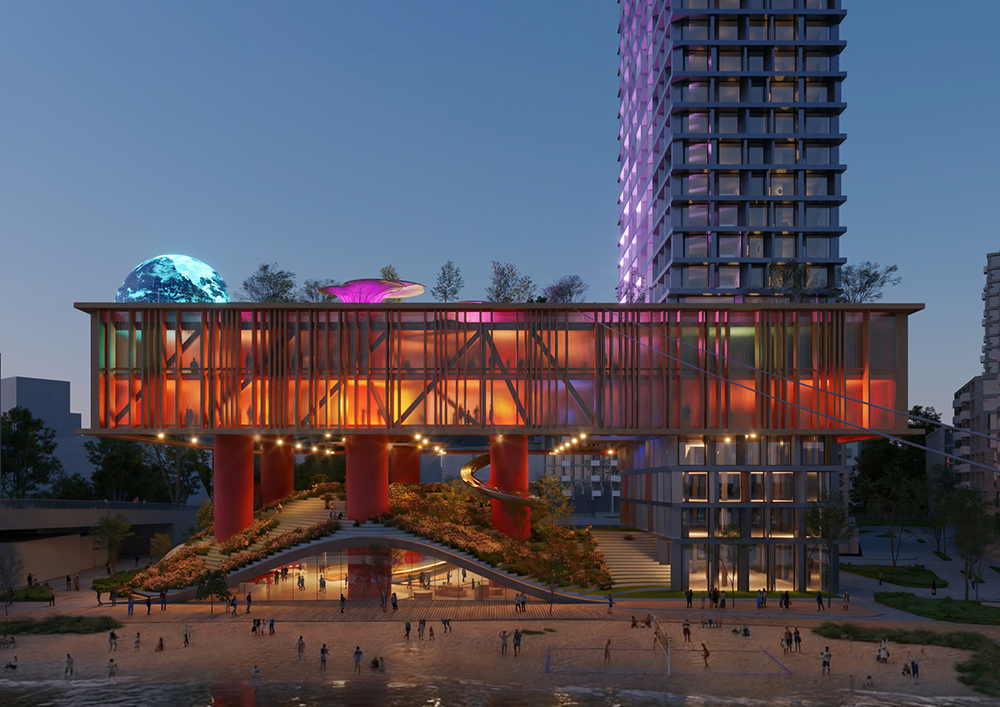
One of the defining features of the House of Shift is its embrace of reused infrastructure. Six red monopiles—massive cylindrical elements originally designed for offshore wind turbines—anchor the elevated structures above ground.
Transported from the sea to the site by ship, these decommissioned components become both structure and narrative. Their scale introduces a dramatic vertical dimension to the complex while demonstrating the architectural potential of upcycling.
Inside two of the monopiles, circular elevators carry visitors upward through the structure. The descent offers more adventurous routes: sculptural staircases, slides, or even a zipline leading toward the surrounding tidal landscape. Movement through the building becomes part of the experience, transforming circulation into an exploration of gravity, height and perspective.
Suspended on these monopiles is the Elysium, a two-storey box formed from reused steel and innovative timber floor systems. At its centre, a circular lightwell draws daylight into the interior and orients visitors within the exhibition spaces.
The Elysium hosts immersive environments that explore planetary systems and the possibilities of behavioural change. Artistic installations and interactive environments encourage visitors to consider their relationship with ecological processes.
The Tower of Change
Rising alongside the landscape elements is the Tower of Change, a vertical structure designed to support research, collaboration and public programming. Constructed from modular cross-laminated timber boxes clad with solar panels, the tower demonstrates an approach to sustainable construction grounded in prefabrication and renewable materials.
The tower houses coworking spaces, event venues and educational facilities alongside hospitality programmes, including a restaurant and a 200-room urban hotel. Large openings frame expansive views of Rotterdam’s harbour landscape, reinforcing the building’s relationship with the delta environment that inspired its creation.
At the top, beneath a crown of solar panels, meeting spaces and a sky bar create a public destination overlooking the city.
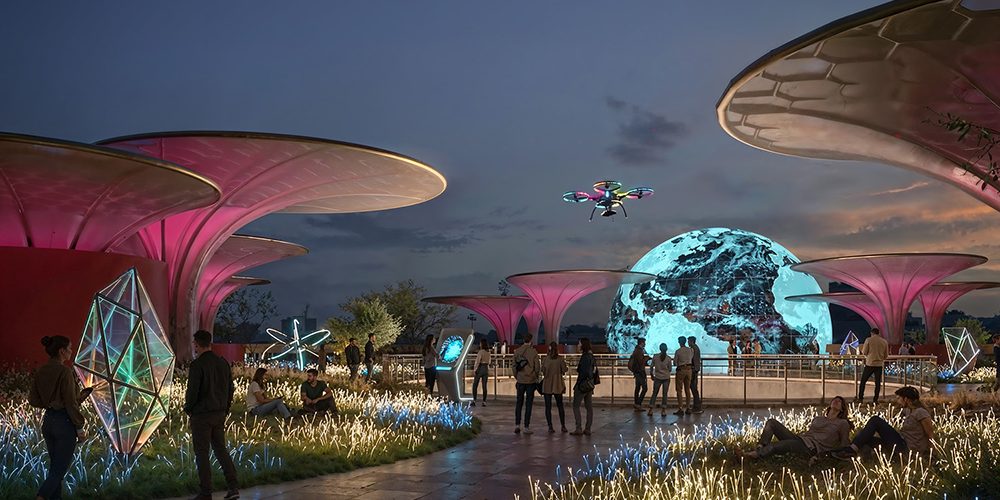
Adjacent to the tower, the Garden of the Senses functions as an elevated observation deck. Solar-powered “trees” rise from the deck, transforming the monopile structures into luminous elements that support events and artistic installations, particularly during sunset and nightfall.
A symbol for Delta Cities
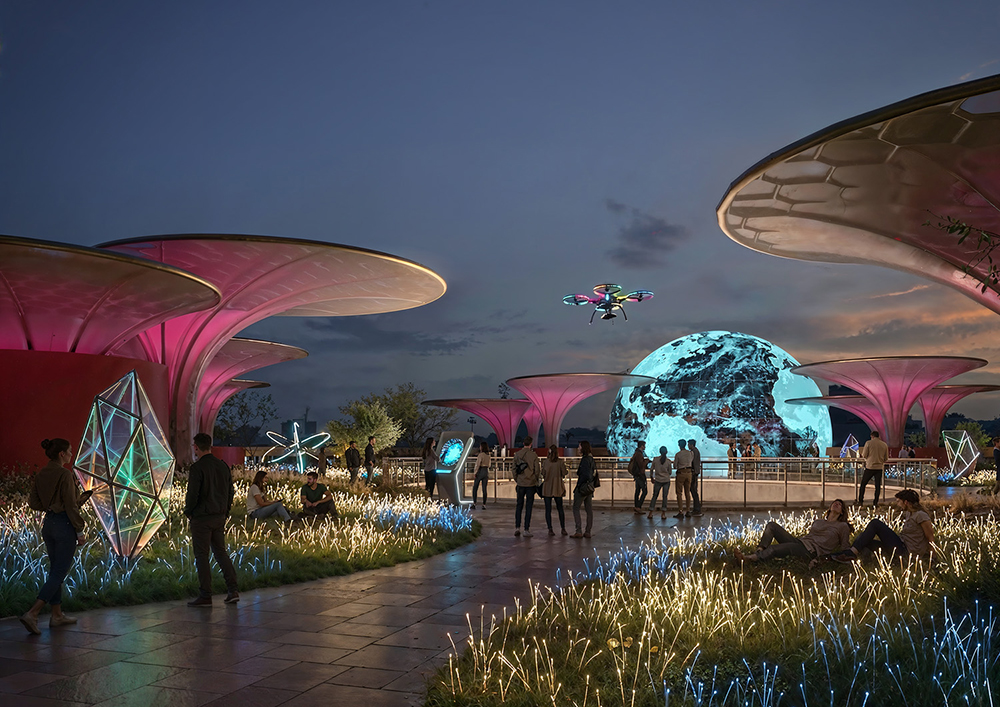
Rotterdam’s identity as a delta harbour city forms the conceptual foundation of the House of Shift. Coastal urban centres face some of the most immediate challenges posed by climate change, from rising sea levels to the pressures of dense populations and resource management.
As the first in a proposed network of similar hubs in harbour cities around the world, the Rotterdam complex acts as both prototype and symbol. Its composition, including hill, tower, box and sphere, reads like a diagram of ecological systems and human intervention.
Through this clarity of form, the House of Shift suggests that sustainability is not only engineered but designed as an architectural culture to be imagined, constructed, and shared.